 MoveBoard
Every order opens in a window: the customer, the move, the price, the addresses and every message, on one screen. Changes stay a draft until you press SAVE.
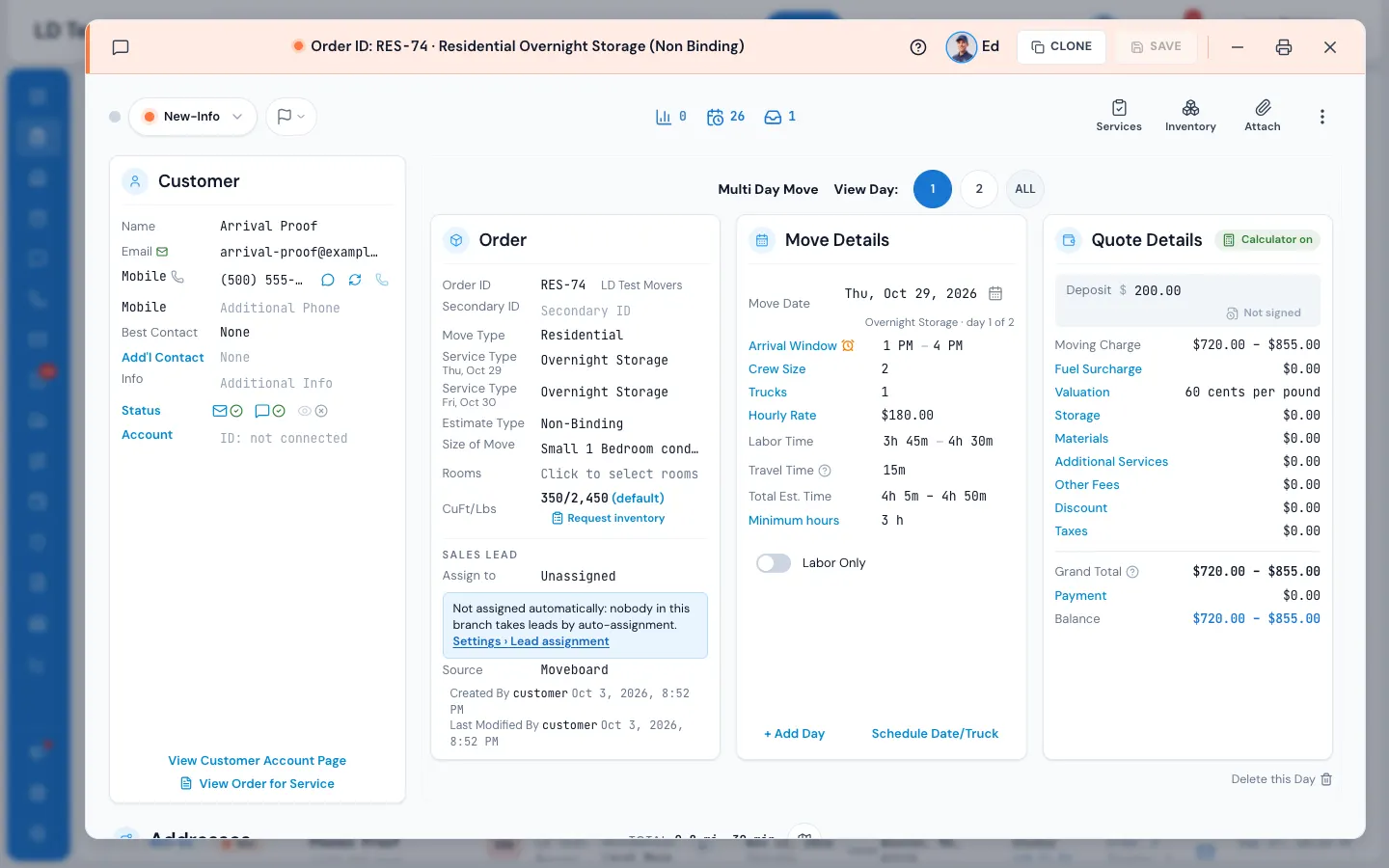
The top bar
The top bar takes the colour of the order's status. From left to right:
- Messages — jumps to the conversation with the customer, with the number unread.
- Order ID and the move type. If a teammate is editing the order, it says LOCKED and RELEASE takes the place of SAVE — see Someone else is in this order.
- ? — this guide. Ed — ask about this order.
- Discard (only when you have changes), CLONE (a new order like this one — save or discard first; see Clone an order), SAVE.
- Minimise, Print, Close.
The strip under it
- The dot shows whether the customer has their portal open right now.
- Status — press it to move the order to another status. The customer and the team hear about it when you save.
- Flags, then the counters: the lead score (when your company uses it), the days until the move, and the customer's total orders.
- On the right: Services (book an in-home or virtual visit), Inventory (with the cubic feet and any special items), Attach, and the ⋮ for Tasks, Invoices, Storage, Change orders, Documents, Claims and Settings. An item comes out of the ⋮ when it has something in it.
The truck schedule
The trucks for the move day, with every booked and reserved job on them and this order standing out. Depending on your company's settings it sits above the cards, at the bottom of the window, or opens from Schedule Date/Truck in Move Details. See The truck schedule in the order.
The four cards
Customer
Name, email and phones, the portal dot, whether they're subscribed to messages, Best Contact (way and time), Add'l Contact, extra Info, Status switches for email, text and portal, the business Account the order belongs to, and the links View Customer Account Page and View Order for Service. More in Customer card.
Order
Order ID and branch, Secondary ID, Move Type, Service Type, Estimate Type, Tariff Type (long-distance days), Size of Move, Rooms and CuFt/Lbs — with Request inventory beside it (see Send the inventory link). Under Sales Lead: Assign to, Source, and who booked, created and last changed the order. If a lead couldn't be assigned, the reason and a link to fix it show here. More in Order card.
Move Details
Move Date, Arrival Window, Crew Size, Trucks, Hourly Rate, Labor Time, Estimated Travel Time, Total Est. Time and Minimum hours, with + Add Day at the foot. The calculator is always on: when you set a value yourself it shows in red, with an arrow that puts the calculator's own figure back. More in Move Details card.
Quote Details
The Deposit row (the amount, what's paid, Text link on orders that can be booked online, and whether the customer has signed), then every charge — moving or labor, travel, fuel, valuation, storage, materials, additional services, other fees, discount, taxes — the Grand Total, Payment and the Balance. More in Quote Details card.
Clone an order
CLONE makes a new order for the same customer, filled in with this order's details: the service and dates, the addresses and stops, the move size, the crew, trucks and rates, the fees, extra services and packing materials, the valuation and the notes. Its quote comes out the same as this order's.
- Save or discard your changes first.
- Press CLONE. MoveBoard asks Also copy the inventory?
- Press Yes, copy it to give the new order its own copy of the inventory (rooms, items, cubic feet, boxes), or No to start it with an empty inventory. With No, an order sized by its inventory becomes sized by move size instead, at the same volume, so the quote stays the same.
- The new order opens in its own window, with the status New.
The two orders share only the customer, so both show in the customer's order history. Nothing else carries over: no trucks, crew or job, no payments, signatures, bill of lading or closing, no messages, files, tasks or automations, and no link to this order's storage move out. Change the new order freely. This order stays as it was, apart from one line in its log saying it was cloned.
Addresses
Each stop is a card with a letter. Press + to add a stop — a ZIP code alone is enough to save it. The map pin opens directions on Google Maps. Distances and times show between the stops. If an address change turns a local move into a long-distance one (or back), MoveBoard asks you right away.
Communication and the Order Log
At the bottom: every text, email, portal message, call and note with this customer on the left, and the Order Log — who did what and when — on the right. Filter the log with Display, and see what each workflow did or is waiting to do.
How SAVE works
- Make your changes anywhere in the window. SAVE lights up and Discard appears as soon as something is changed.
- Press SAVE. If something is missing for the status you chose — a truck, a street address, the customer's details — MoveBoard says what and stops.
- The Order Updates window lists every change, for example "Status: Reserved to Booked".
- If you changed the status, the messages that go with the new status show as chips. Press the eye to preview one, its name to change the words, or ✕ to not send it.
- Press Save. Your changes are written, then the messages go.
The details are in How saving works in an order.